Medtronic has launched a voluntary exchange offer allowing shareholders to tender MDT shares in return for shares of MiniMed [MMED], the diabetes‑focused business being spun off. The offer provides a slight economic incentive. Tendering shareholders receive more MMED value than MDT value tendered, subject to an upper limit and potential proration if the offer is oversubscribed.
It’s early 1917. Charles S. Moomy, the vice president of his father’s business, Keystone Rubber Manufacturing Company in Erie, Pennsylvania, decides he wants to go out on his own. He has been saving up and he has connections. But he’s going to stick with what he knows – and that’s rubber. And because synthetic rubber is still in its experimental stages, we’re talking natural rubber, the stuff that has to be harvested from mature trees that grow thousands of miles away. He meets with James T. Johnstone, a New York City rubber broker, who secures for him a large batch of crude rubber (most likely from southeast Asia) and invests $30,000 of his own money as well. Charles purchases $4,000 worth of rubber making machinery and gets an agreement from Montgomery Ward & Company to buy the bicycle inner tubes he plans to make.
This new company of perhaps 65 employees begins operations in Carlisle, Pennsylvania on September 12, 1917. A decade later, the company has over 300 employees and is making 10,000 inner tubes per day. But the next decade, the one that includes the era we refer to as The Great Depression, nearly bankrupts the business. It was touch and go. There were loans. There were sacrifices. And it survived.
Fast forward nearly 100 years, we have ourselves a massively successful, publicly traded company, or rather collection of companies, that can proudly say they are one of fewer than 60 companies with 50+ years of consecutive dividend increases. The headquarters are now in Scottsdale, Arizona, but they haven’t forgotten where it all began…
In October of 1863, Major James Lide Coker is injured and captured by Union forces at the Battle of Chickamauga. After his release, and less than two years later, an undeterred Coker delivers food supplies to Confederate forces stationed in Richmond, Virginia. Upon his return home to Hartsville, South Carolina, he learns General Sherman has destroyed his family farm. When there is nothing else left in your life but land and seed, your path forward seems narrow but clear – and it isn’t tripling down on the Confederate cause. Coker borrows an old mule and a pair of oxen from an uncle and sews 100 acres of farmland with corn seed and cotton seed and the fruits of that labor and land net him a small fortune.
Fast forward 30+ years, through several successful business launches, and Major Coker is struggling to get a paper making business off the ground in his hometown. He and his namesake son have overcome a number of problems, but one sticky one remains – resin-heavy pine trees gum up the machines and make unusable paper. Eventually they perfect the process but find a lack of customers to be financially crippling. Nearly bankrupt, Major Coker makes another great pivot, replacing the cumbersome and expensive wooden cones on which yarn for textiles is threaded, with paper cones.
The entity founded in 1899 and originally known as the Southern Novelty Company would begin paying dividends in 1925 and it hasn’t stopped. And though they would deny it, they just raised their quarterly dividend for the 50th straight year.
Today, Somnigroup International Inc [SGI] and Leggett & Platt Inc [LEG] announced that they have signed a definitive agreement pursuant to which SGI will acquire LEG in an all-stock transaction valued at approximately $2.5 billion based on SGI’s closing share price of $78.06 on April 10, 2026.
However, the price on Friday is of no interest to shareholders of LEG. Under the terms of the agreement, LEG shareholders will receive 0.1455 shares of SGI in exchange for each share of LEG they own.
LEG is up over 12% and SGI over 2% as of the time of this post. But the real question is what does this mean for the largest position in the Portfolio for the Ages?
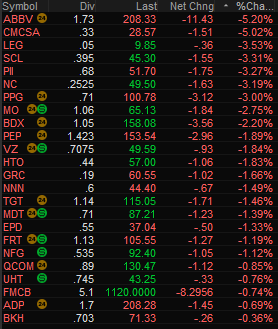
This marks the first time since inception that every position, and the portfolio has never had more positions, declined on the same day. This was a genuinely rare event for a 24-stock portfolio well-diversified across all 11 sectors. And while SPXEW’s 1.29% drop was hardly mild — that’s a legitimately rough day by any historical standard — it still wasn’t the kind of broad‑market capitulation one would normally associate with a complete sweep across every holding.
It’s infuriating, and in my view, unmistakably tied to the reckless geopolitical decisions made less than a month ago and still unfolding today.
Five colleagues left Litton Industries in 1966 with a plan to go it alone and sell high‑altitude research balloons. The balloons didn’t sell. So, they tried vacuum‑forming plastic canoes. The canoes didn’t sell either. Then came computer software and then, naturally, leather footwear. By 1968, one cofounder had died, three had bailed, and the lone survivor—staring down bankruptcy—brought in an outside investor and bought a failing paper mill, mostly because at that point, why not.
Against all odds, good management actually turned the paper business around, and those profits fueled a long run of acquisitions. Paper eventually gave way to power tools, which gave way to industrial equipment, which gave way to pumps and valves. Today, the whole enterprise has reinvented itself yet again—this time as a focused water‑technology company.
Founded in Minnesota, later headquartered in Switzerland, then incorporated in Ireland, with tax residency in the United Kingdom, yet still keeping its main U.S. office right back in Minnesota, this company of product pivots and postal codes apparently has the financial stability and discipline required to raise dividends for 50 consecutive years.
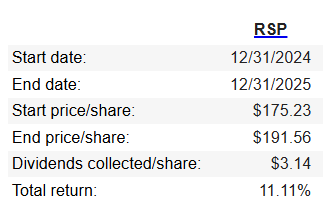
On 2025-12-31, the equally weighted S&P 500 Index [SPXEW] closed at 7,763.92, up 9.3% for the year excluding dividends. To assess the performance with dividends, it is convenient to look at the total return of the Invesco S&P 500 Equal Weight ETF [RSP].
The dividends yielded 1.8%. The real question: How did the Portfolio for the Ages do?
Two adjustments have been made to the weekly ranking process, prompting a refreshed presentation of the investment plan. The modifications are minor refinements; eight stocks remained consistent across both the previous and revised methods applied to this week’s Top Ten.
As of market close on 2025-11-10, the ten largest tickers by market capitalization within the S&P 500 Index [SPX] represented a staggering 43% of the entire index. That’s a first in the history of the index which goes back to the late 1950s. That’s right, never before has just 2% of the tickers comprised over 43% of the Index value.