
In October of 1863, Major James Lide Coker is injured and captured by Union forces at the Battle of Chickamauga. After his release, and less than two years later, an undeterred Coker delivers food supplies to Confederate forces stationed in Richmond, Virginia. Upon his return home to Hartsville, South Carolina, he learns General Sherman has destroyed his family farm. When there is nothing else left in your life but land and seed, your path forward seems narrow but clear – and it isn’t tripling down on the Confederate cause. Coker borrows an old mule and a pair of oxen from an uncle and sews 100 acres of farmland with corn seed and cotton seed and the fruits of that labor and land net him a small fortune.
Fast forward 30+ years, through several successful business launches, and Major Coker is struggling to get a paper making business off the ground in his hometown. He and his namesake son have overcome a number of problems, but one sticky one remains – resin-heavy pine trees gum up the machines and make unusable paper. Eventually they perfect the process but find a lack of customers to be financially crippling. Nearly bankrupt, Major Coker makes another great pivot, replacing the cumbersome and expensive wooden cones on which yarn for textiles is threaded, with paper cones.
The entity founded in 1899 and originally known as the Southern Novelty Company would begin paying dividends in 1925 and it hasn’t stopped. And though they would deny it, they just raised their quarterly dividend for the 50th straight year.
All hail Sonoco Products Company!

Both Major James Lide Coker and the Sonoco Products Company [SON] have a fascinating history, and I would encourage even the disinterested to check it out on the company website and Wikipedia.
Before we move on, let me make it clear: this is not the Sunoco of gas station fame.
According to Schwab:
Sonoco Products Company, together with its subsidiaries, designs, develops, manufactures, and sells various engineered and sustainable packaging products in the United States, Europe, Canada, the Asia Pacific, and internationally. The company operates in two segments, Consumer Packaging and Industrial Paper Packaging. The Consumer Packaging segment offers round and shaped rigid paper, steel, and plastic containers, as well as metal and peelable membrane ends, closures, and components. Its Industrial Paper Packaging segment provides paperboard tubes, cones, and cores; paper-based protective packaging; and uncoated recycled paperboards. The company also offers packaging materials, such as plastic, paper, foam, and various other specialty materials. It sells its products in various markets, including the paper, textile, film, food, packaging, construction, and wire and cable markets. The company was founded in 1899 and is headquartered in Hartsville, South Carolina.
In other words, companies make products and SON makes the packaging. In fact, they still make those paper cones for yarn. There are 265 facilities in 37 countries employing 22,000+ individuals.
SON becomes the 6th Dividend King from the Materials sector. Below is a list of all the Kings in the sector and the sub-industry in which they conduct their business.
| Company | Ticker | Sub-Industry |
| H.B. Fuller Co | FUL | Specialty Chemicals |
| Nucor Corp | NUE | Steel |
| PPG Industries Inc | PPG | Specialty Chemicals |
| RPM International Inc | RPM | Specialty Chemicals |
| Stepan Co | SCL | Specialty Chemicals |
| Sonoco Products Co | SON | Paper & Plastic Packaging Products & Materials |
In their 2026-04-15 press release, president and CEO Howard Coker1 claims it is the 43rd consecutive year that Sonoco has increased its dividend. However, my examination of their detailed dividend history, once available on their official website but no longer extent on the internet2, reveals a 50-year dividend increase streak. Untangling that streak through the many splits, stock dividends3, and special dividends isn’t what I’d call spiritually uplifting, but it’s exactly the sort of thing you visit Royal Dividends for—that, or because it’s free and likely because you had nothing better to do.
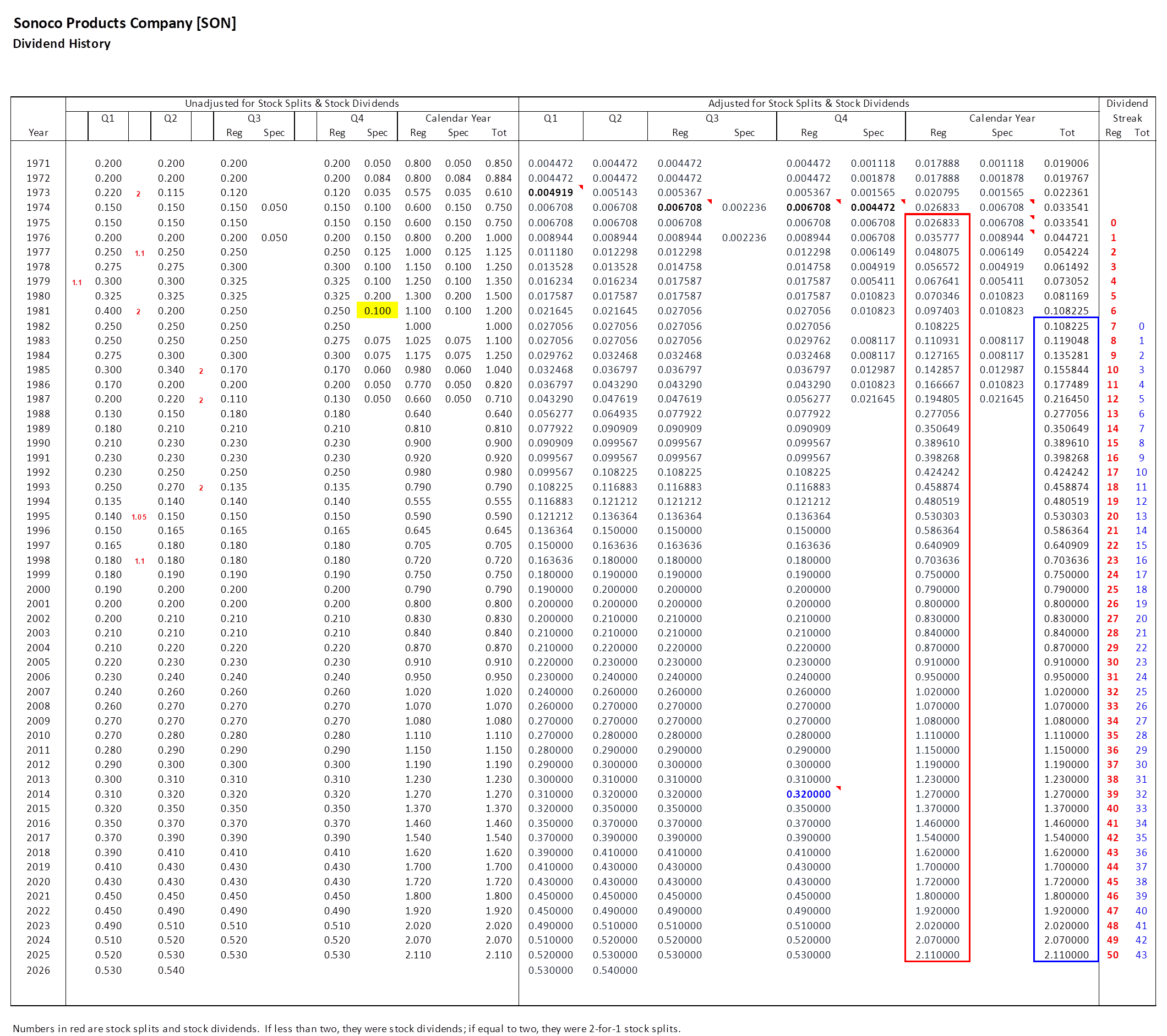
SON appears to be including the impact of special dividends in their determination and the $0.10 special dividend paid in the fourth quarter of 1981 (yellow highlight) was large enough to prevent 1982’s dividends from exceeding 1981’s dividends. This resets a 7-year streak back to 0.
However, it is conventional to ignore any special dividends paid when determining if a year’s dividend exceeds that of a previous year.
For what it is worth, I wrote to the head of investor relations at SON, stating that I truly believe they have an opportunity to claim a 50-year streak, but I have not received a response.
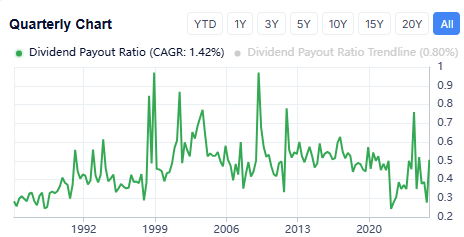
The 2025Q4 dividend of $0.53 was well supported by earnings and the payout ratio implies the dividend is safe and has been for quite sometime.
I expect dividends to increase annually for the next seven years, and SON will officially announce their achievement then.
Perhaps by then SON will have found its way into the Portfolio for the Ages.
- I believe Howard Coker, the current president and CEO of SON, is a fourth generation Coker family member. He is probably a great-grandson or very close generational equivalent. For some reason his relationship to Major James Lide Coker is not made clear in the official biography on their website. Regardless, Cokers or individuals who married a Coker have always been at the helm.
↩︎ - The Roundhill Investments S&P Dividend Monarchs ETF [KNGS] tracked the performance of Dividend Kings and listed SON as a stock in its portfolio. I contacted Roundhill and S&P Global for an explanation for their inclusion given Sonoco’s own claim of a shorter streak. Roundhill responded only to state that their portfolio was built from data supplied by S&P Global and S&P Global never responded to my inquiries. KNGS discontinued in late 2024. The historical dividend data was more comprehensive than what is currently shown on Sonoco’s website and back in early 2024, I could only get to a 48-year streak. Now with two more years of increases, the 50-year streak is established. Perhaps the more detailed dividend data is still available on the Wayback Machine, but that is for someone else to explore.
↩︎ - Stock dividends are not the same as cash dividends. Stock dividends are a distribution of additional shares instead of cash.
They are usually expressed as a percentage, for example a 5% stock dividend gives you 5 extra shares for every 100 you own. Your ownership percentage stays the same, because everyone gets the same proportional increase and the stock price adjusts downward to keep the market cap unchanged. For purposes of adjusting historical dividend levels, their mathematical treatment is identical to that of stock splits. ↩︎