
Today, Somnigroup International Inc [SGI] and Leggett & Platt Inc [LEG] announced that they have signed a definitive agreement pursuant to which SGI will acquire LEG in an all-stock transaction valued at approximately $2.5 billion based on SGI’s closing share price of $78.06 on April 10, 2026.
However, the price on Friday is of no interest to shareholders of LEG. Under the terms of the agreement, LEG shareholders will receive 0.1455 shares of SGI in exchange for each share of LEG they own.
LEG is up over 12% and SGI over 2% as of the time of this post. But the real question is what does this mean for the largest position in the Portfolio for the Ages?
LEG rejected SGI’s first offer of $12.00 per share of LEG earlier this year. With SGI currently trading near $80.00 it would seem that they pulled a Costanza and held out for less money, because .1455 x $80 = $11.64. However, we don’t yet know the official date on which this transaction will take place. The deal is expected to close before year-end 2026 and it is subject to shareholder approval on the LEG side.
For what it is worth, the breakeven point between the original offer of $12.00 is 12.00/.1455 = 82.47. Assuming LEG shareholders approve of the transaction, if SGI’s share price is trading above $82.47 on the day the transaction takes place, one could say the second deal was better than the first. Of course, if the share price is trading below that level, most LEG shareholders will say management sold us out.
Not me. I approve of the agreement.1 Let me explain.
Had I received $12.00 per share of LEG, would I have been happy? No.
That is why measures were taken (options were sold) so that if that first offer had been accepted, Royal Dividends would have been out of the LEG position with a small profit long before the closure date.
If I had not sold options and simply took in the proceeds from the sale at $12.00, would I have immediately used those proceeds to acquire shares of SGI? No.
But if LEG shareholders accept this second offer, you’re essentially hopping off one train onto another. So, let’s explore the future from that perspective and bear in mind we have 9 call contracts with a strike price of $12.50 expiring on 2026-09-18.
Transaction is Not Approved
If the transaction is not approved by either regulators or LEG shareholders, nothing changes – we hope that LEG’s turnaround story continues and that exploration of any further deals are not so costly they weigh significantly on future EPS levels.
Transaction Takes Place Before 2026-09-18
I don’t feel this is very likely, but it is theoretically possible for the deal to close in under 5 months. If that is the case:
- Our 900 shares of LEG will become 130 shares of SGI.
- Any fractional shares will likely receive a cash equivalent based on the share price of SGI at the time.
- The call options will be adjusted on the date of the transaction. Instead of seeing LEG 09/18/26 12.50 C in the option chain listing, you will see something like LEG1 09/18/26 12.50 C (Deliverable: 14.55 SGI) or SGI1 09/18/26 12.50 C (Adj). Each contract would represent 14.55 shares of SGI instead of 100 shares of LEG. And the ‘moneyness’ of the calls will be determined by taking SGI’s price, multiplying it by .1455, and comparing it to $12.50.
In other words, if SGI is trading at $85.95 or higher on 2026-09-18, the calls will be in the money, and our 130 shares of SGI will be called away and the position closed out at a small profit and Royal Dividends will be rather pleased with the outcome.
If SGI is trading below $85.95 on that fateful day, we will simply sell 1 call representing 100 shares of SGI such that, if that call were to expire in the money, we could close out the whole of the position (the covering shares and the remaining 30) at a profit.
Calls Expire Before Transaction Takes Place
If on 2026-09-18 the deal still has not closed, a very likely situation, we care only about where LEG and SGI are trading. If LEG is above $12.50 (which would imply SGI is north of $85.95), our shares will be called away for $12.50 and our position will be closed out at a small profit.
If LEG is under $12.50 but over $11.90, we would see the calls expire worthless, but I will likely sell all 900 shares because the position would still be closed out at a profit albeit a negligible one.
If LEG is under $11.90, i.e. the worst-case scenario, we will wait for the transaction to take place before considering selling another call.
The Reality
The goal is still to close out the position, whether it is 900 shares of LEG or 130 shares of SGI. Neither firm is a member of the Royal Dividends Empire, and therefore, not a position we wish to be in for the long haul.
The past ten years have shown an interesting departure in price performance.
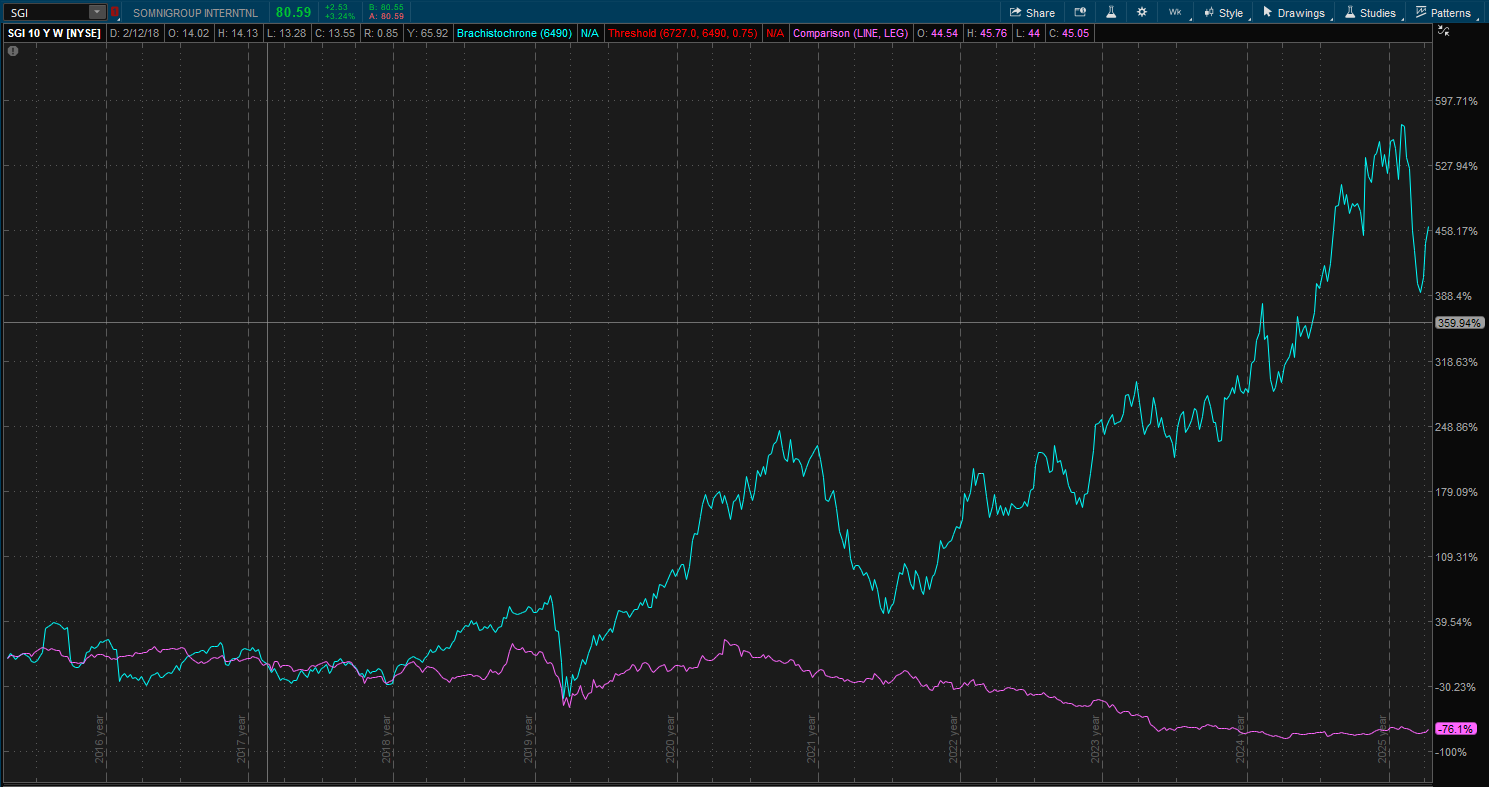
It’s as if both got Covid in early 2020, and both recovered shortly thereafter. But in the summer of 2022 SGI got vaccinated and LEG learned it has long-form Covid.
The worst-case scenario: we hop off of a slow-moving train with vending machines to a faster train with food service. And sure, maybe after we hop on there is an unexpected delay or two, but even with delays, there is a greater likelihood we reach our destination sooner.
- A shareholder of either company should read the agreement announcement (link provided at the top of the post). That hyperlink is provided not as a source to prove I’m not lying, but to make it easy to read and understand the particulars of the agreement and what the management of each company believe will be the end result. And though a shareholder is certainly entitled to their opinion, more often than not, it will be an uninformed one, even after having read the press release. There are no better individuals than those involved in the decision to move ahead with the transaction than the management of both companies, so it is wise to acknowledge that and make a decision to hold, sell, or buy more shares accordingly.
The ‘explanation’ of my unsolicited, positive opinion on the matter leaves out the synergies discussed in the press release, because my repeating that information doesn’t do anyone any good. But my leaving them out doesn’t mean I don’t buy into them – again, these are the most informed individuals. Will management always look out for themselves? Yes. But will they also look out for shareholders? Yes. The anticipated synergies are significant and probable and are, in fact, the foundation of my desire to see this get approved by all parties. What follows after this footnote is simply a breakdown of the possible scenarios going forward and a conclusion that even in the worst case we’ll be better off with SGI shares.
↩︎