
SGI has acquired LEG. The nine outstanding call contracts were adjusted per the terms of the all-stock transaction and expired worthless on Friday. Now we can sell exactly one call on our 130 shares of SGI. SGI has more available options both in terms of expiry dates and strike prices than were available for LEG so the following recommendation is perfect for our position and should execute quickly.
Sell to Open: One February 19, 2027 $80.00 Call Option [Symbol: SGI270219C80]
Limit Order Price: Credit of $2.95 per share
Nothing Changes and Yet Everything Has to Change
I have adjusted all of the historical transactions on LEG as if they had been made on SGI. This method preserves the exact dollar amounts, but alters the share counts and share prices such that we would end up exactly where we are today.1
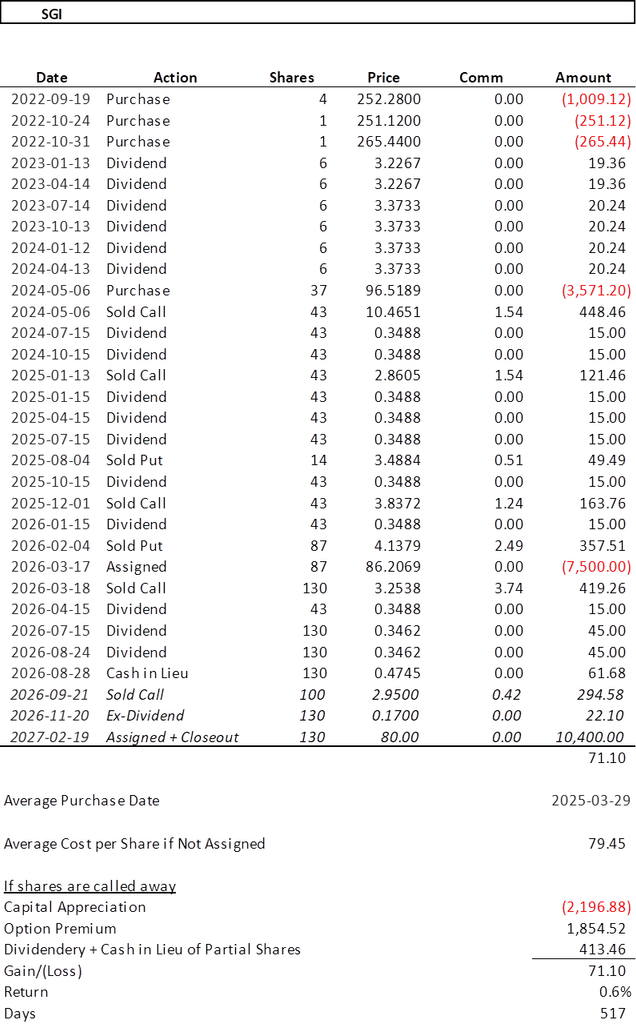
Between now and 2027-02-19 we can expect just one dividend of $22.10 for our 130 shares. However, in the rare event SGI skyrockets well above $80 and we have our shares assigned prior to the ex-dividend date of 2026-11-20, our position would still be closed out at a profit. In fact, so long as the call sells for at least $2.47 per share2, the position could still be closed out for a profit, regardless of whether we collect that dividend prior to assignment.
More likely is that we collect that dividend and thirteen other dividends, the equivalent of the call option premium of $294.58 after commissions. So that’s 14 dividends or 3.5 years’ worth of dividends in the next 150 days or so. If SGI climbs above $80, we will see 100 shares assigned for $8,000 and we will sell the remaining 30 shares for no less than $80 or $2,400 and the position will have closed out for a small profit.
Of course, there is an 80% chance that SGI is not above $80 come 2027-02-19 and we repeat this process all over again. Nothing changes.
Although SGI’s headline dividend yield sits at just 1.07%, the actual income it produces in our portfolio is far more substantial. Collecting $2.9458 twice a year on 100 shares and $0.17 four times a year on all 130 shares lifts the effective yield dramatically. When you total those payments and compare them against the cost basis of the 130‑share position, the yield rises to 8.2% on today’s closing price of $63.36. In other words, while SGI may appear to be our lowest‑yielding holding on paper, made worse by being our largest position, it delivers more income per share than any other stock we own.
That being said, I cannot wait until we close this position. I hate it dearly.
- Please note, that if one were to have gone back in time, these transactions would not have been possible with SGI. For instance, SGI likely did not trade for the prices shown on the days it was hypothetically purchased, it did not pay those quarterly dividend amounts, and one cannot sell covered calls for fewer than 100 shares per contract. ↩︎
- Though I would begin my limit order at a credit of $2.95, if price movement is such that I have to come down from that level, I would consider dropping all the way to $2.50 in order to ensure that eventual assignment at $80 gets me in the black. ↩︎