On January 3, 2024, Walgreens Boots Alliance Inc. [WBA] announced that its next quarterly dividend will be $0.25. That should amount to $1.00 per share for calendar year 2024, a generous yield of 4%. Unfortunately, that $1.00 per share will be a 48% drop from the dividends paid in 2023 and the end of a 48-year dividend increase streak.
On May 4, 2023, Johnson & Johnson [JNJ] split off a significant portion of its consumer healthcare business, representing approximately 17% of its revenue. On July 20, 2023, this new company declared its first quarterly dividend of $0.20, reminding investors why it is a Dividend King. Whaaaat?!
Well, it turns out there are, if not rules per se, considerations that determine whether a parent company’s streak of paying and increasing dividends shall be passed onto or inherited by a newly created company in a divestiture. Those considerations take into account whether the new company was a significant component of the parent company, whether it will pay a dividend of its own, the size and yield of both dividends before and after the divesture, and who knows what else. But here’s the thing: you and I don’t decide. In this case, S&P Global Inc [SPGI], themselves a Dividend King, made the decision.
On August 22, 2023, S&P Global made the announcement that this newly formed company would be added to the S&P 500 Dividend Aristocrats Index. A company does not make it into this distinguished list unless they’ve increased their dividend for a minimum of 25 years. Further, because JNJ is a Dividend King with a 61-year increase streak, one can logically assume that this entire streak, and not some lesser streak between 25 and 61 years, is what has been inherited. And thus, Sure Dividend has concluded that this newly created company is in fact a Dividend King and I see no reason to argue.
On St. Patrick’s Day 1839, the Northwestern Bank of Virginia opened a branch in Parkersburg. Now, I know what you’re thinking. That has to be a mistake, right? Everybody knows there are nine cities by the name Parkersburg in America and not a one of them in Virginia. There’s one in Georgia, Illinois, Indiana, Iowa, Mississippi, North Carolina, Oklahoma, Oregon, and West Virginia. There is no Parkersburg, Virginia!
Oh, Dear Reader. You were so quick to demonstrate your geographical knowledge of America, you missed a small detail that means everything – the year. Now it’s all coming back to you in a flash. Before June 20, 1863, the area we now lovingly refer to as the state of West Virginia was simply the northwestern part of a much larger state, Virginia. The city known today as Parkersburg, West Virginia was Parkersburg, Virginia and thus, a perfectly fine location to launch the first branch of the Northwestern Bank of Virginia. Of course, we could ask why they didn’t choose Bank of Northwestern Virginia as the name. But the more important questions are: ‘Is the bank still around?’ and, if so ‘What name does it go by today?’
The answer(s): Yes. It eventually became a part of United Bankshares, Inc and they just became a Dividend King.
In 1885, the Statue of Liberty arrives in New York Harbor. That same year sees the formation of the St. John’s Electric Light Company in the province of Canada now known as Newfoundland and Labrador. Some 40 years later, the company is renamed, not Electric Light Orchestra, but Newfoundland Light & Power Co. Limited. In 1987 it becomes the first wholly owned subsidiary of a holding company named Fortis Inc, created specifically to hold Newfoundland Light & Power, but also to expand and diversify. More decades pass and yada, yada, yada…. that holding company announces their 50th year of consecutive dividend increases.
A hospital in town plays a lullaby over the PA system throughout the building whenever a child is born in the Maternity Ward. Once, I was visiting my sick mother there and heard the pleasant tune and asked why it was playing. When I learned, I teared up a little. It is just a simple reminder that there are wonderful things in the world, even when things aren’t going so well.
As you might expect, I keep an eye on companies with long dividend increase streaks. So, it isn’t really a surprise when a company hits their 50th consecutive year of such increases, becoming a Dividend King. Do I tear up a little? No. But it is still a wonderful thing, even when the stock market doesn’t seem to care.
There’s a 76-year-old company that is doing what it has always done. Providing all sorts of materials for builders and DIYers all over the world. Honestly, I wouldn’t be surprised if 50% of what I see in Home Depot or Lowe’s is produced by this company. Ever heard of Rust-Oleum? DAP? Kwik-Seal? Come on! Roto-Rooter? Sure, you have. Essentially this company is your friend whenever you’ve gotten yourself too deep into a home project. On October 5th, they made an announcement that makes them a Dividend King.
The Portfolio for the Ages came to life with the acquisition of FMCB, a little-known Dividend King, on July 18, 2022. There are now 15 positions covering all 11 sectors and one can see the performance and portfolio characteristics at the relevant menu links1.
Save the stock price performance of TDS, the portfolio’s performance has been a disappointment. I have to emphasize that it is TDS’s price performance that has been phenomenal, as its business performance has been the worst of any of the holdings. And if that doesn’t tell you something about investing in the short term, I’m not sure what does. I am deliberately passing on the opportunity to compare the Royal Dividends portfolio performance to that of SPX or NOBL at this time, in order to stress the importance of dividend accumulation.
Update: Later, on the same day as the original post, I asked Bing what ABBV’s current dividend is, and received the correct answer of $1.48 per share. Immediately, I wondered why Bing nailed it this time. Then, I became aware that my setting for Bing was ‘More Creative’ (as opposed to ‘More Balanced’ or ‘More Precise’). This likely explains the parallel universe that I accidentally stepped into earlier that day. It doesn’t explain why it waited until I was a few iterations deep when it decided to get ‘creative’. Why didn’t it just respond with ‘chicken‘? That’s very creative. And why get creative with what is already historical fact? Should I have expected that? Shouldn’t ‘creativity’ be used in less factual arenas, like dreams or forecasts or emotional discussion? Do we need to play around with irrefutable historical fact? I still think the previously unspoken, yet implied warning about AI applies; use multiple sources to verify information provided to you, particularly if from a source you have not used previously. My main source for all things related to dividends, earnings, and fair valuation, is Sure Dividend. When I need additional detail, I venture out into other sources such as Yahoo! Finance, CFRA reports, and TD Ameritrade, and make sure that I reconcile back to my control totals. This fruitless venture into AI as detailed below was an effort to get quarterly dividends that would tie back to the yearly dividends easily obtained from the latest ABBV report available through my Sure Dividend membership. No one source is perfect, but Sure Dividend aims to be. Be careful out there, humans.
I am writing on September 15, 2023. I just completed a rather surreal chat with the AI-powered, Microsoft Bing add-on available in the Microsoft Edge browser. Life may never be the same.
I’d like to think Blaze Bayley came up with the title I chose for this post, but there are historians who would beg to differ. In his song ‘The Brave‘, we have the lines:
Fortune favours1 the brave Risking it all again and again Fortune favours the brave Fall after fall they climb up again
When is the last time you thought about linseed? Have you even seen that word in print lately? Did you know that linseed and flaxseed are the same thing? The seeds come from the common flax plant (linum usitatissimum) and if you’re crushing or pressing the seeds for human consumption in the form of fiber or oil, we tend to call it flaxseed. When the seeds are processed for the purposes of making furniture polish, paints, or cloth (linen…now we’re seeing things oh so clearly) then linseed is the more common term. Maybe. The truth is the terms are interchangeable and the use in the UK differs from American English.
So, you likely know that if you take a spoonful of flaxseeds and grind them up you have a small amount of flax meal you can add to a smoothie or baked goods for extra nutrition. Or you can add the whole seeds directly to some dough for a tasty multigrain bread. But do you know what you get if you scale your production way up and process tons and tons of linseed? You get rich.
There’s a company that has been crushing linseed for over a hundred years and on January 26, 2023, they announced a dividend increase that represents 50 consecutive years of annual increases in their dividend, making them a Dividend King.
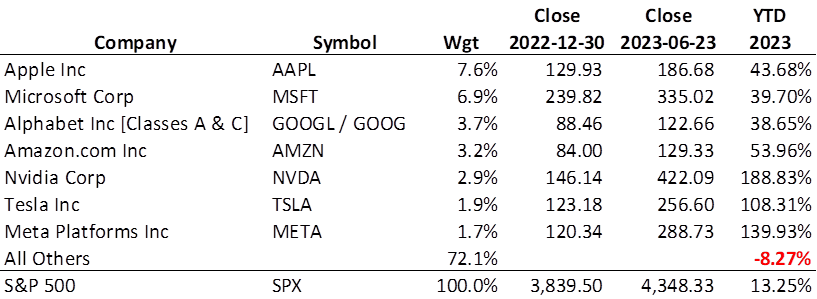
The stock market was down this week, a small correction from an otherwise good, multi-week run-up. In fact, the S&P 500 is up 13.25% YTD through June 23, 2023 (ignoring dividends). You’d never know it by looking at the Portfolio for the Ages. But let’s not look at the Royal Dividends portfolio just yet. Instead, let’s take a look at the seven largest companies by weight in the S&P 500.
Surprised? These seven companies, effectively 1.4% of the number of companies1 in the index, represent a whopping 27.9% by weight. The S&P 500 Index is market capitalization weighted and is heavily influenced by these overpriced juggernauts. The weighted average YTD price return of the magnificent seven is an enormous 68.7%. This means the remaining 493 companies are delivering a wonderful -8.27% YTD. Taking dividends into account would improve this gap ever so slightly, but let’s get real here – the S&P 500 in no way represents the broader equity market.
Unless you have decent exposure to the big seven, the market has been garbage.