General

Coronation! [PNR]

Five colleagues left Litton Industries in 1966 with a plan to go it alone and sell high‑altitude research balloons. The balloons didn’t sell. So, they tried vacuum‑forming plastic canoes. The canoes didn’t sell either. Then came computer software and then, naturally, leather footwear. By 1968, one cofounder had died, three had bailed, and the lone survivor—staring down bankruptcy—brought in an outside investor and bought a failing paper mill, mostly because at that point, why not.

Against all odds, good management actually turned the paper business around, and those profits fueled a long run of acquisitions. Paper eventually gave way to power tools, which gave way to industrial equipment, which gave way to pumps and valves. Today, the whole enterprise has reinvented itself yet again—this time as a focused water‑technology company.

Founded in Minnesota, later headquartered in Switzerland, then incorporated in Ireland, with tax residency in the United Kingdom, yet still keeping its main U.S. office right back in Minnesota, this company of product pivots and postal codes apparently has the financial stability and discipline required to raise dividends for 50 consecutive years.

All hail Pentair plc!

Performance Update [6]

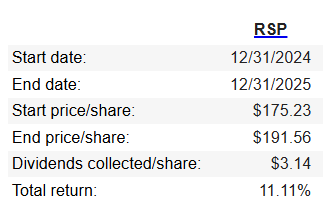
On 2025-12-31, the equally weighted S&P 500 Index [SPXEW] closed at 7,763.92, up 9.3% for the year excluding dividends. To assess the performance with dividends, it is convenient to look at the total return of the Invesco S&P 500 Equal Weight ETF [RSP].

The dividends yielded 1.8%. The real question: How did the Portfolio for the Ages do?

Going Forward [3]

Two adjustments have been made to the weekly ranking process, prompting a refreshed presentation of the investment plan. The modifications are minor refinements; eight stocks remained consistent across both the previous and revised methods applied to this week’s Top Ten.

Concentration Risk

As of market close on 2025-11-10, the ten largest tickers by market capitalization within the S&P 500 Index [SPX] represented a staggering 43% of the entire index. That’s a first in the history of the index which goes back to the late 1950s. That’s right, never before has just 2% of the tickers comprised over 43% of the Index value.

What does that concentration actually look like?

FMCB Goes to a Quarterly Dividend

To the casual observer, it would appear that FMCB just paid a smaller dividend than the one previous to it, a disastrous event for a Dividend King. However, that $5.00 dividend was the first quarterly dividend in FMCB’s long history. That’s right, on 2025-08-13, in conjunction with the declaration of that $5 dividend, FMCB announced that the Company is changing its dividend policy related to the frequency of cash dividend payments from semi-annually to quarterly.

This news, in addition to the announcement of a massive increase to their share repurchase program can only help put FMCB on the radar. These announcements make FMCB a more attractive investment and that in turn should help the stock close the gap between where it trades today and a fair value that is closer to $1,500.

Coronation! [MGEE]

It’s after dusk in Madison, Wisconsin, July 19, 1855. Legislators have just gaslit the public and about 2,000 people have marched to the steps of the Capitol. When they get there, a few of the area’s more notable politicians deliver a series of impromptu speeches. Were it not for a hard rain that came during the fourth speech, resulting in the dispersal of the crowd, things could have gotten dark – but thankfully, the lights stayed on.

Gaslighting wasn’t always a bad thing. Back in 1855, the Madison Gas Light & Coke Company had just been granted exclusive rights to illuminate the city’s streets with gas-powered lamps. The 2,000 people who marched to the Capitol that evening weren’t duped by months of political deceit—they were genuinely thrilled. Their gathering wasn’t a protest, but a celebration of progress: the arrival of streetlamps that would finally light up Madison’s nights. In that moment, “gaslighting” meant something entirely different—it meant turning darkness into light.

Over the next 170 years, the Madison Gas Light & Coke Company would evolve—changing names, expanding its footprint, and adding a constellation of related businesses. Its modern incarnation has paid uninterrupted cash dividends for more than 110 years. On August 15, 2025, it marked a milestone few companies ever reach: 50 consecutive years of dividend increases. With that announcement, a new Dividend King has officially joined the Royal Dividends Empire.

All hail MGE Energy Inc!

Performance Update [5]

On 2024-11-29, the equally weighted S&P 500 Index [SPXEW] reached an all-time high of $7,612.31. SPXEW found itself down 20% from the all-time high on 2025-04-07. Since then, the market has climbed nearly all the way back and is now down just 2.5% from the high. In fact, just three days ago, the market weighted S&P 500 Index [SPX] reached a new all-time high. But that’s essentially all because of Nvidia [NVDA] which has doubled since April 7th.

The Portfolio for the Ages turns three today. It has not doubled since April 7th. Let’s talk about that.

Feeling Undervalued

The S&P 500 Index [SPX] at 5,976.97 is just 170.46 points shy of its all-time high of 6,147.43 achieved on 2025-02-19. It feels inevitable that SPX will establish a new all-time high in short order. If it does achieve a new all-time high, how sustainable will that level be? Could it go even higher?

Let’s examine just one metric for both SPX and the Portfolio for the Ages: P/E ratio.

SJW Group Rebrands as H2O America

Throughout history, many monarchs have adopted a new name upon ascending to the throne—a practice known as taking a regnal name. Popes follow a similar tradition. In a comparable move, SJW Group [SJW], which has been a Dividend King for the past seven years, has decided to rebrand itself as H2O America [HTO].

I highly encourage reading the press release in the link above. They discuss their motivation and even the new logo. Rebranding in a way that emphasizes both the importance of water and a national platform, is a GREAT decision.

Coronation! [RLI]

I was about 35 years old when I finally caved in and got myself some glasses. I hate wearing glasses, but not because of how they look. It’s the constant pushing them back up my nose. It’s the irritation above the ears from the constant use. Before I needed bifocals, I certainly had the option of buying contact lenses, but I chose not to. They cost more than glasses – and I already disliked having to spend any money at all on the matter.

In the 1960s, the cost of replacing a pair of contact lenses was about $200. Many of the younger cohort inclined to wear contact lenses found this replacement cost to be prohibitive. But of course, the cost wasn’t about to stop them from choosing contact lenses over glasses and so, contact lens insurance was born. One of the first contact lens insurers was founded by Gerald D. Stephens in 1965 and it became one of the largest of its kind in the United States.

Over time, the demand for the insurance diminished with the emergence of more affordable, disposable soft lenses. In order to remain competitive, Stephens began offering other types of insurance, including commercial property and liability insurance. The company eventually got out of the contract lens insurance line altogether and thrives in the property and casualty industry today. In fact, on 2025-02-13, they announced a dividend increase making this the 50th straight year of doing so. We have ourselves another Dividend King in the Royal Dividends Empire.

All hail RLI Corp!

Scroll to Top