
This week, five of the portfolio holdings ranked in the Top Ten.
| Ticker | Account Value |
| ADP | 5,170.72 |
| CMCSA | 3,830.40 |
| HTO | 4,064.10 |
| PEP | 3,394.00 |
| PPG | 3,650.13 |
The lowest amount belongs to PEP. We will acquire 2 shares of PEP on Monday morning. Below, is the purchase history and average cost calculation.
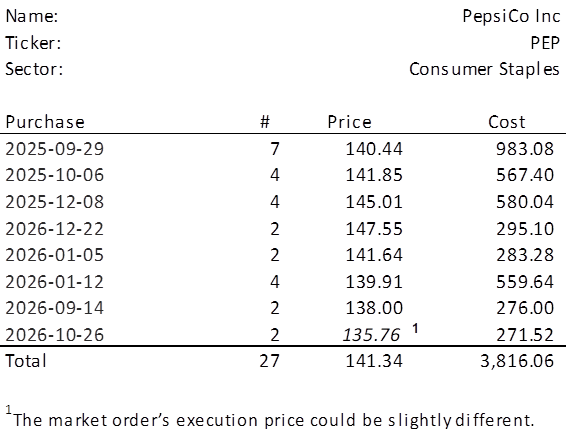
Nearly six weeks have passed since we added to this position, but there was an earnings announcement in that time. Let’s see how this recent performance fits into the broader arc of the past seventeen years.
Observations
Stock Price
After reaching an all-time high of 196.88 in May of 2023, PEP’s share price has gone through a rather long and volatile price consolidation. On 2026-09-14, I noted that PEP was approaching support around the $127 level, and whaddya know, it dropped all the way to $123.47, the day before earnings were announced.
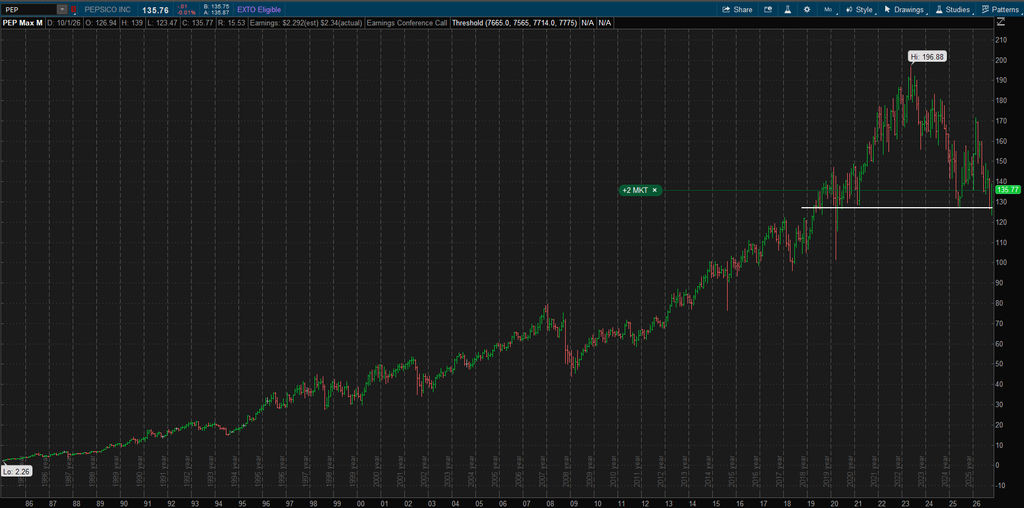
Thankfully, the market responded positively to the quarterly earnings the very next day and the stock has been slowly moving up ever since. This bounce off of the support area is a good sign.
Earnings
Magnitude/Trend
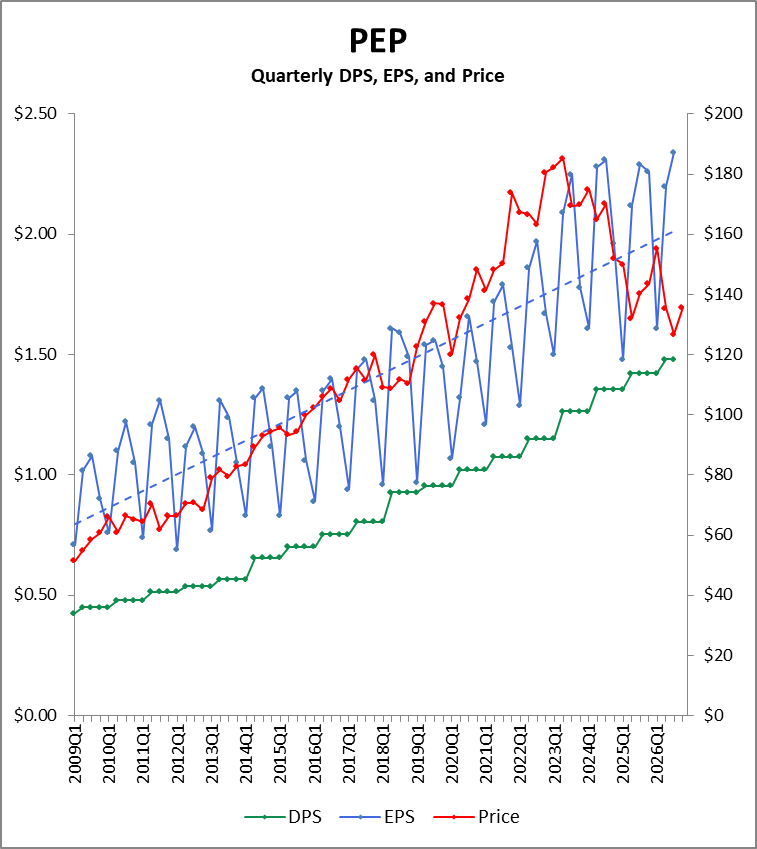
Clearly, the quarterly earnings remain in a strong, long-term, positive trend as is depicted by the linear, blue dotted line in the chart above. 2026Q3 EPS of $2.34 is a 2.2% improvement over the same period in the prior year. In fact, it is $0.03 higher than 2024Q3 earnings, the previous all-time high for quarterly earnings. The first three calendar quarters are 4.4% higher than the same period of the prior year.
Seasonality
Typically, the quarterly distribution of annual earnings breaks down as follows: 18.3% in Q1, 27.6% in Q2, 29.0% in Q3, and 25.1% in Q4. Remarkably, the variation around these percentages is minimal. The difference between the halves of the calendar year is a bit more pronounced with the first half typically coming in at 45.9% and the second half at 54.1%.
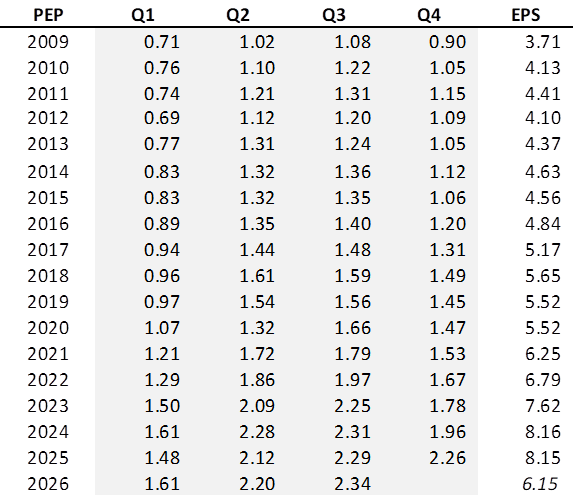
With the first three calendar quarters clocking in at $6.15, and the historical average of said time frame representing nearly 75% of a full year’s earnings, it isn’t difficult to see how CY2026 will set a new record. The share price is a different matter – it wouldn’t surprise me to see it trade down to $100.
Dividends
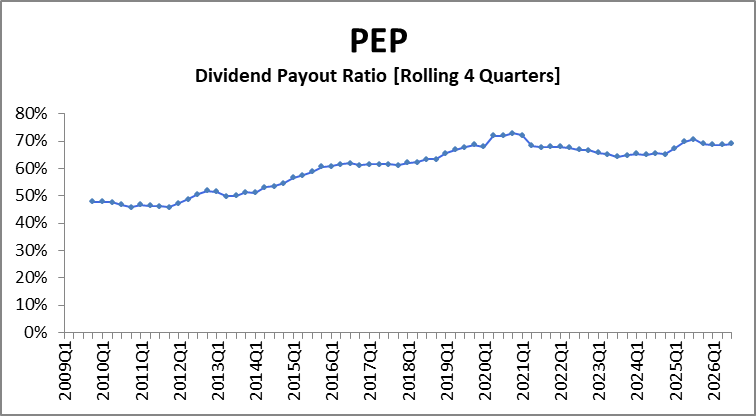
PEP is a Dividend King, with an impressive 54-year streak of consecutive dividend increases. The dividend currently yields 4.4%, while the payout ratio remains quite safe at just under 70%.
Interestingly, that 4.4% yield is the highest level seen over the 17-year period shown above. While the payout ratio has steadily increased over that time, it has essentially flattened out over the past seven years. Given PEP’s long track record and the stability of its payout ratio in recent years, I expect the dividend to continue growing safely for the foreseeable future.
Thoughts on Investment
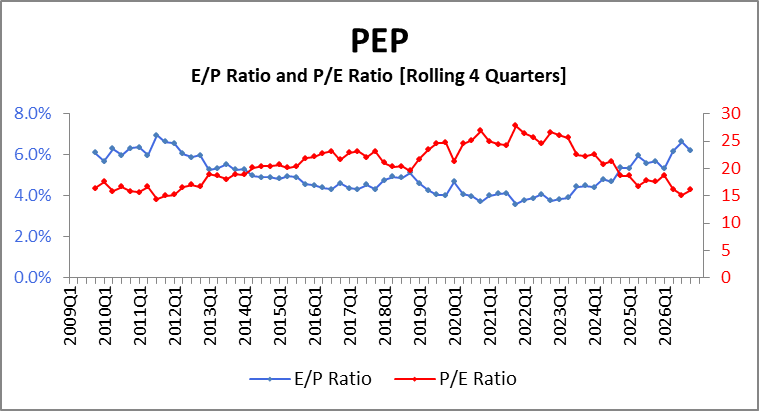
The trailing 12-month P/E ratio is currently 16.14, lower than the average for PEP of 20.70 over the period above.
Whether or not CY2026 will set a record for EPS, there is nothing to suggest PEP won’t keep raising its dividend annually. Furthermore, perhaps PEP’s annual growth rate won’t rival the past, and the stock may deserve a lower multiple. But as low as 16.14? I’m doubtful. And I’m not the only one.
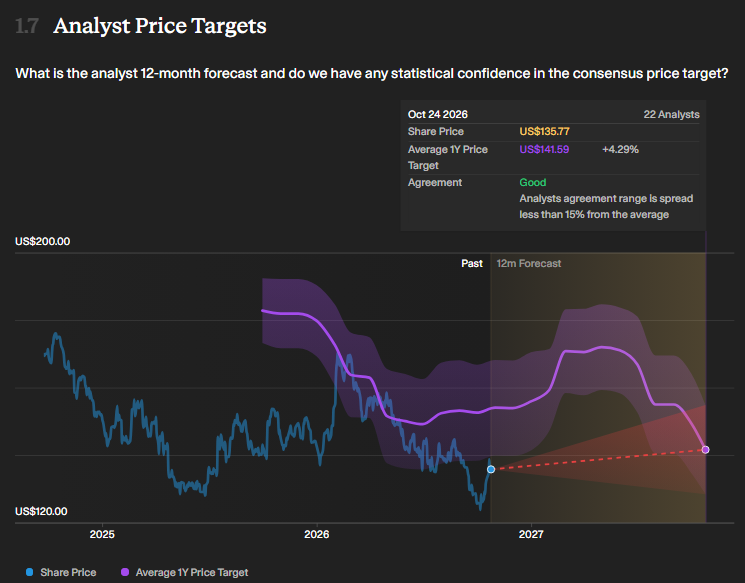
CFRA, GuruFocus, Morningstar, Sure Dividend, and Simply Wall St, have their fair value estimates or 12-month targets falling within a range of $142 to $184.
Simply Wall St. says there are 22 analysts following PEP and that their 12-month target averages out to $142. However, they have a display that shows the range about that average estimate and also how that range and average have tracked over the recent past as well. It makes for a great visual:
The recent reduction in PEP’s 2026 earnings outlook lowered the midpoint of management’s guidance from approximately $8.63 per share to $8.39 per share. The revised forecast appears to reflect ongoing weakness in North America and continued margin pressure. Importantly, it does not appear to incorporate the subsequent announcement that KFC will transition its U.S. beverage business from PepsiCo to Coca-Cola [KO] beginning in 2027.
There is no denying that the loss of the KFC U.S. account is a setback. While PEP will remain the beverage supplier for KFC’s international operations, the decision represents the loss of a long-standing domestic partnership. That said, the impact is partially offset by the company’s strong international growth and an 11-year extension of its beverage partnership with Taco Bell through 2036.
On balance, the market’s reaction appears to reflect concerns about slowing earnings growth and North American performance more than the future loss of the KFC contract itself.
Next year is going to be a critical year for PEP. Until then the attractive 4.4% yield should be safe and we’re encouraged that the share price has bounced off of the support level in the mid $120s.